
“El gobierno no ha sido creado para hacer ganancias, sino para hacer justicia”
Juan Bautista Alberdi
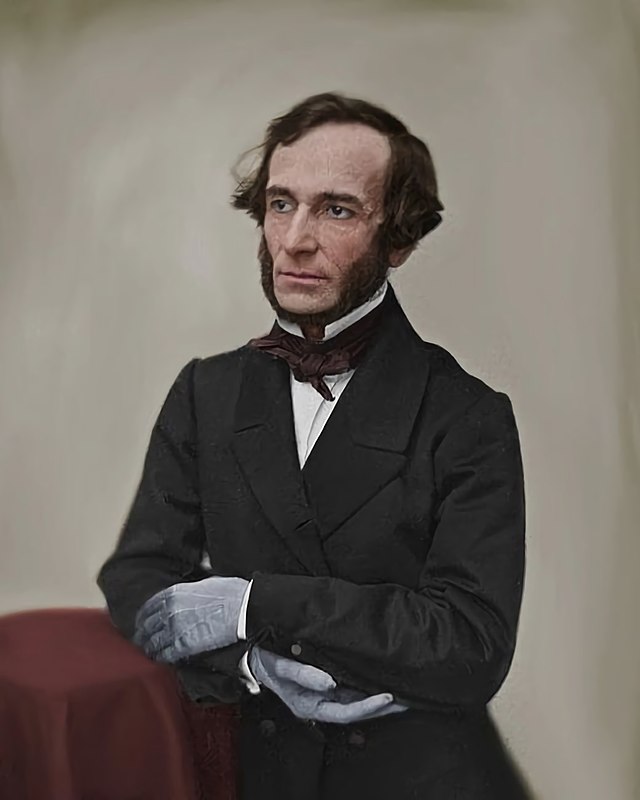
Juan Bautista Alberdi was an Argentine lawyer, diplomat, and politician, hailed as one of the most influential figures in Argentine history. Born on August 29, 1810, in Tucumán, Argentina, Alberdi played a crucial role in shaping the nation’s political and legal landscape during the 19th century.
Alberdi is best known for his work as the principal author of Argentina’s Constitution of 1853, which established the country as a federal republic. His ideas were instrumental in promoting the principles of liberalism, constitutionalism, and free trade, which he believed were essential for fostering economic development and political stability.
Throughout his career, Alberdi authored numerous essays and political treatises, including his seminal work «Bases y puntos de partida para la organización política de la República Argentina» (Bases and Starting Points for the Political Organization of the Argentine Republic). In this work, he outlined his vision for a modern and progressive Argentine state based on the principles of individual freedom, limited government, and the rule of law.
In addition to his contributions to constitutional law, Alberdi also served as a diplomat, representing Argentina in various international forums. He was a staunch advocate for Latin American unity and cooperation and played a key role in promoting regional integration efforts.
Juan Bautista Alberdi’s legacy continues to influence Argentine politics and jurisprudence to this day. His commitment to democracy, liberalism, and constitutionalism remains a guiding force in the nation’s ongoing quest for progress and development.
"Los argentinos hemos sido ociosos por derecho y holgazanes legalmente. Se nos alentó a consumir sin producir. Nuestro pueblo no carece de alimentos, sino de educación, y por eso tenemos pauperismo mental.
En realidad nuestro pueblo argentino se muere de hambre de instrucción, de sed de saber, de pobreza de conocimientos prácticos y de ignorancia en el arte de hacer bien las cosas. Sobre todo se muere de pereza, es decir de abundancia. Quieren pan sin trabajo, viven del maná del Estado y eso les mantiene desnudos, ignorantes y esclavos de su propia condición. El origen de la riqueza son el trabajo y el capital,
¿qué duda cabe de que la ociosidad es el manantial de la miseria? La ociosidad es el gran enemigo del pueblo en las provincias argentinas".
Paraguay
Alberdi fue una de las mentes más lúcidas en denunciar que la contienda contra el Paraguay constituía una masacre fratricida al servicio del capital británico y de la oligarquía porteña. En su tratado El crimen de la guerra (redactado durante el conflicto) y en sus escritos desde el exilio, Alberdi desmontó la mentira de la «gesta civilizadora» de Mitre, denunciando que se estaba destruyendo al país más autónomo de la región para subordinarlo al Imperio del Brasil y a la banca de Londres.
¿Cuál era el pensamiento de Juan Bautista Alberdi?
En las Bases escribió su lema central: Gobernar es poblar. Criticó al estatismo de la herencia colonial hispana, principal barrera, en su opinión, al progreso de la América independiente.
Bases y puntos de partida para la organización política de la República Arjentina
Alberdi and the French Model for Argentine Development
Juan Bautista Alberdi adopted the model proposed by Lerminier to position Argentines as the torchbearers of development in Latin America.
In the late 1820s, Lerminier, a French lawyer and journalist, had urged the French intelligentsia to create a homegrown philosophy. This philosophy would synthesize the best ideas from the most powerful country in Europe (then Germany) with the foundational principles of the French nation: liberty and equality. Lerminier believed this synthesis would re-establish France’s lost cultural leading role on the continent, with education promoting the idea of French excellence, rooted in its philosophical tradition of progress and modernity.
Adapting the Vision for Argentina
Alberdi applied this framework to Argentina. He believed that Argentinian intellectuals should mix French thought with the ideals of the May Revolution. He designated France as the model for Argentina as well as for the rest of Latin America.
Initially, Alberdi argued that education would civilize the «instinctive» and «barbarous» people of the Americas—a view he would later discard. For Alberdi, the primary task of nation-building was to formulate a modern philosophy and model of civilization that could integrate local realities, peoples, and traditions, though he never clearly defined those realities.
Like his fellow members of the Generation of ’37, Alberdi was academically trained in the ideas of French Enlightenment philosophers such as A.L.C. Destutt de Tracy, Pierre-Jean-George Cabanis, and Constantin-François Volney. His training made it more natural for him to expand on foreign ideas than to delve into an unexplored native culture.
Proclaiming Kinship with France
Alberdi openly proclaimed Argentina’s kinship with France in his book Fragmento preliminar al estudio del derecho (1837). He argued that after expelling the Spaniards and establishing a republic, Argentines were the “children of France.” He added that “our democratic institutions form part of the history of French ideas. French thought envelops and penetrates our republican life.”
He also co-opted the idea from French Enlightenment thinkers who, inspired by the success of the American Revolution, stated that America was the daughter and heiress of Europe, and, consequently, the leader of the world’s future civilizing projects.
